


By Kingsley Wheaton, Chief Corporate Officer, BAT
I want to start not with tobacco, not with nicotine, and not with our industry. I want to start with something much simpler: a pattern in human history.
History rarely asks us to give something up. More often, it asks us to find a better way to keep it.
Nobody solved the dangers of the open flame by asking people to live without warmth. They built the chimney, then the stove, and eventually the heat pump. The old solution isn't debated out of existence. It's outcompeted by something better.
There is no requirement for innovation to be perfect for it to be considered progress. It only has to be meaningfully better than the technology it was intended to replace.
I'd suggest that is the single most useful lens we have for understanding where we stand today.
The question we've been asking wrong
For a long time, the public conversation about smoking has collapsed a series of very different questions into one. Smoking is dangerous became tobacco is dangerous. Tobacco is dangerous became nicotine is dangerous. And somewhere in that chain, the delivery mechanism, the thing that actually does the majority of the damage, almost disappeared from the conversation entirely.
But here is the distinction that changes everything: the danger in smoking has never really been that people enjoy nicotine. It's that they obtain it by inhaling the products of combustion.
Once you frame the problem that way, mechanically rather than morally, the question stops being “how do we eliminate nicotine?” It becomes “how do we eliminate burning tobacco to get it?”
That is a solvable problem.
Safer, not safe
I want to be precise about language, because I think it matters more than we sometimes give it credit for. “Safe” is an absolute. “Safer” is a comparison. Almost nothing in daily life clears the bar of “safe”. Nothing that follows from ordinary human activity is completely free of risk.
So the question was never, and should never be, “is this product completely safe?” The question that actually matters, the one that determines outcomes for the nearly 1.1 billion adults around the world who currently smoke and will not quit, is: compared with what?
Compared with a burning cigarette, what does a smoke-free, or in the case of nicotine pouches, inhalation free, alternative offer? That is the only comparison that has ever mattered to the person who is smoking today, not next decade, not once every study has reported back, but today.
And I think scientists, regulators, public health voices in this room, owe that person an honest answer to that question.
Why this isn’t a one person job
Here is where I want to be direct with you. No single regulator or health body working in isolation is going to shift this on its own.
The transition away from combustion is, at its core, an infrastructure problem, a trust problem, and an evidence problem, all three at once. It needs manufacturers competing to bring to market reduced risk profile products. It needs regulators willing to build proportionate frameworks, ones that treat a smoke-free product differently from a burning cigarette, because the risk genuinely is different. It needs independent science that the public can actually trust. And it needs all of us, be you regulator, scientist or public health expert, willing to put aside differences because the goal in front of us is bigger than any one of us.
Sweden is the case study that should make this urgent. It’s within touching distance of becoming Europe's first smoke-free country. In a political union built on shared standards, you'd expect that result to be studied, and replicated at speed. Instead, progress on Smokefree 2040 across the rest of Europe has been modest at best.
That is why the clarion call I want to leave regulators, scientists and health experts with today is: this is a moment for joining forces, not guarding territory. It's a shared ambition, and it will only be reached if we treat it as one.
What that means for BAT
So let me tell you what we're doing about it.
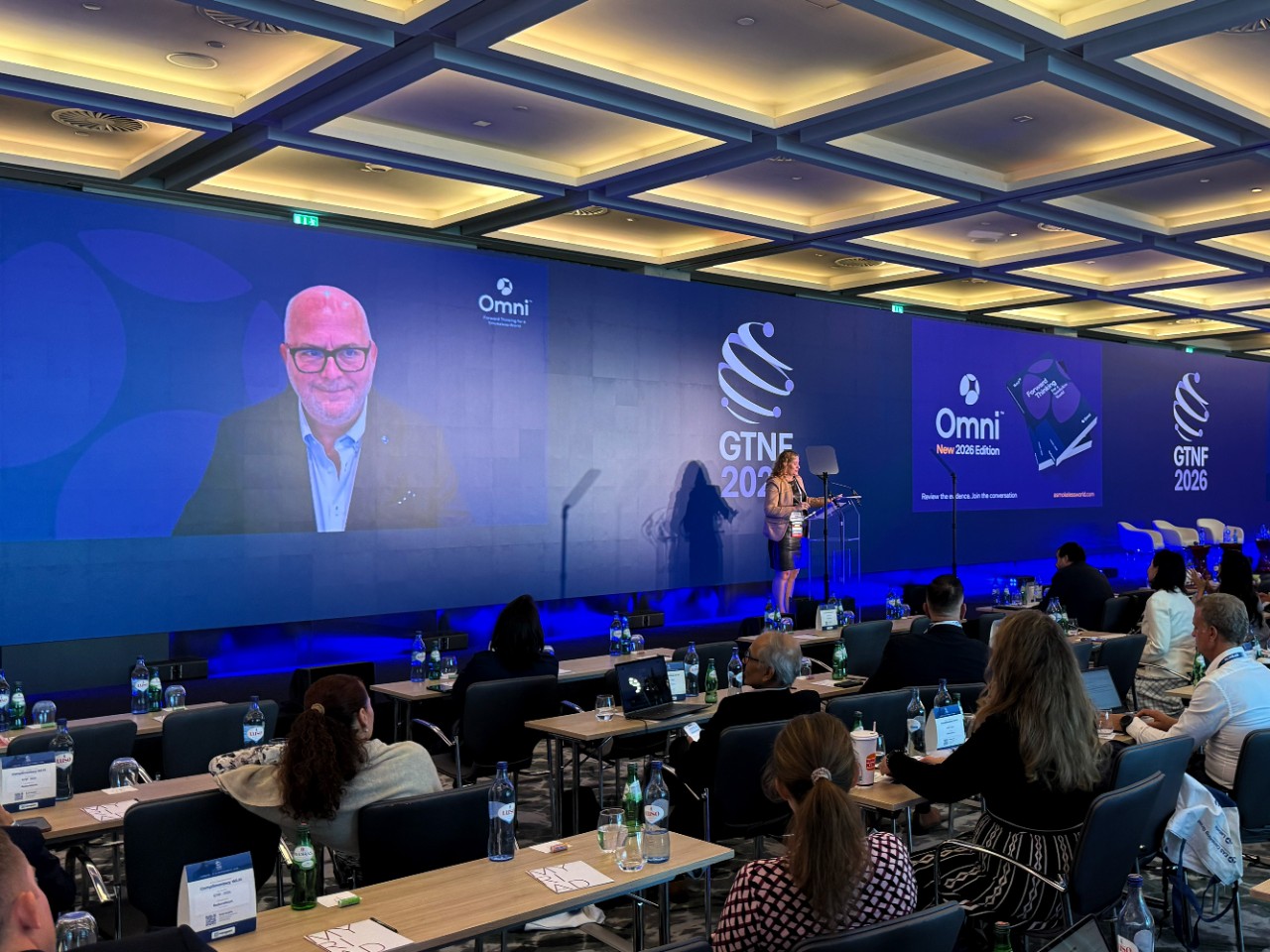
Today, for the first time publicly, I want to announce an update to our Omni™ platform.
Omni™ is our platform for gathering the evidence base around tobacco harm reduction. What we're launching today is a significant update to it, bringing in the latest case studies, the most current scientific research, and real-world evidence from markets where smoke-free products are already reaching adult smokers at scale.
In some ways, it's easier to say what Omni™ isn't than what it is. It isn't a book, a report, or a website, though it can look like all three. It's a manifesto and a mandate: a manifesto for change, and a mandate for action, as we work toward becoming a predominantly smokeless business.
The purpose of Omni™ is not to tell you what to think. It's to ignite the conversation with stakeholders. It's a resource built to be scrutinised, challenged and built upon, not a closed argument, but an open one. The very premise on which we built The Smokeless Word, where guests including two former prime ministers share their points of view, and how they see tackling the problem. Because if we are asking regulators and scientists and public health bodies to engage with the evidence on harm reduction, the very least we owe them is to make that evidence visible, current and rigorous.
That is what “safer” requires of all of us. Strong evidence. Not waiting for absolute certainty. Honesty, and a willingness to keep the evidence in daylight.
We are heading into a pivotal moment for Europe, with TPD 3 on the horizon, and beyond Europe even, with COP in 2027. More and more markets are recognising the role of tobacco harm reduction in those global conversations That should give us confidence, but not complacency. The opportunity is for a smarter TPD, and a Europe with fewer smokers; the risk is that over-regulation pushes adult smokers towards illicit markets and creates a contagion effect that is far harder to control.
The direction, not the destination
I said earlier that history rarely delivers change through a single dramatic moment. Cigarettes are unlikely to disappear because of one declaration, one deadline, one summit. They are far more likely to become obsolete the way the typewriter and the fax machine did: not banned, but gradually displaced by something better, until burning tobacco simply no longer makes sense as the way people consume nicotine.
That is not a slower ambition than prohibition. It may be the only one that actually works, because it is the only one built around what people, in the real world, actually do.
So here is what I would ask of everyone in this room. Ask “compared with what,” every time. Hold the evidence to a high standard, and then act on it once it clears that standard, rather than waiting for an absolute certainty. Because the person still smoking today who won’t quit does not have the luxury of waiting for us to sort out our differences first.
Not safe. Safer. And then safer again. That is the goal.
With this I leave you with one simple ask: review the evidence, join the conversation.