

Our ambition - contributing to a Nature Positive1 future.
Our operations depend on, and impact nature. We rely on natural resources to grow and manufacture our products, while activities such as sourcing, farming, and water use can negatively impact nature.
In turn, environmental degradation can disrupt our supply chain and business resilience.
Our commitment to nature goes beyond managing impacts and dependencies. It is also about driving meaningful change. To mitigate nature loss, we have a series of targets in place addressing areas such as deforestation, land conversion and water use.
We aim to contribute towards a Nature Positive* future by protecting, restoring, and replenishing ecosystems.
2030 targets
- Water Positive in our own operations2
- Deforestation Free across our primary deforestation-linked commodities3
- 100% of prioritised water-stressed agricultural basins with water stewardship programmes
- 65% of directly-contracted arable land adopting regenerative agriculture practices
How we’ll get there
Our Group Environment Policy and Biodiversity Statement outline our approach for mitigating our environmental impacts.
We manage the impacts of our activities and sites by implementing internal standards as adapted. These include our Soil and Groundwater Protection Standard, Water Security Standards, and Biodiversity Operational Standard on Tobacco Farming (BOS). Through nature-based solutions and capacity-building programmes, we support our directly-contracted farmers to mitigate the degradation of natural capital, which may impact the long-term resilience of our business and their livelihoods.
Read more about our sustainability policies and procedures at: Sustainability Policies, Procedures and Standards
Find out more on our Nature initiatives and performance in our 2025 Combined Annual and Sustainability Report and 2025 Sustainability Performance Data Book.
Our nature strategy is anchored on the adoption of the mitigation hierarchy in line with the Science Based Targets Network’s (SBTN) AR3T framework, supporting the targets of the Kunming-Montreal Global Biodiversity Framework (GBF).
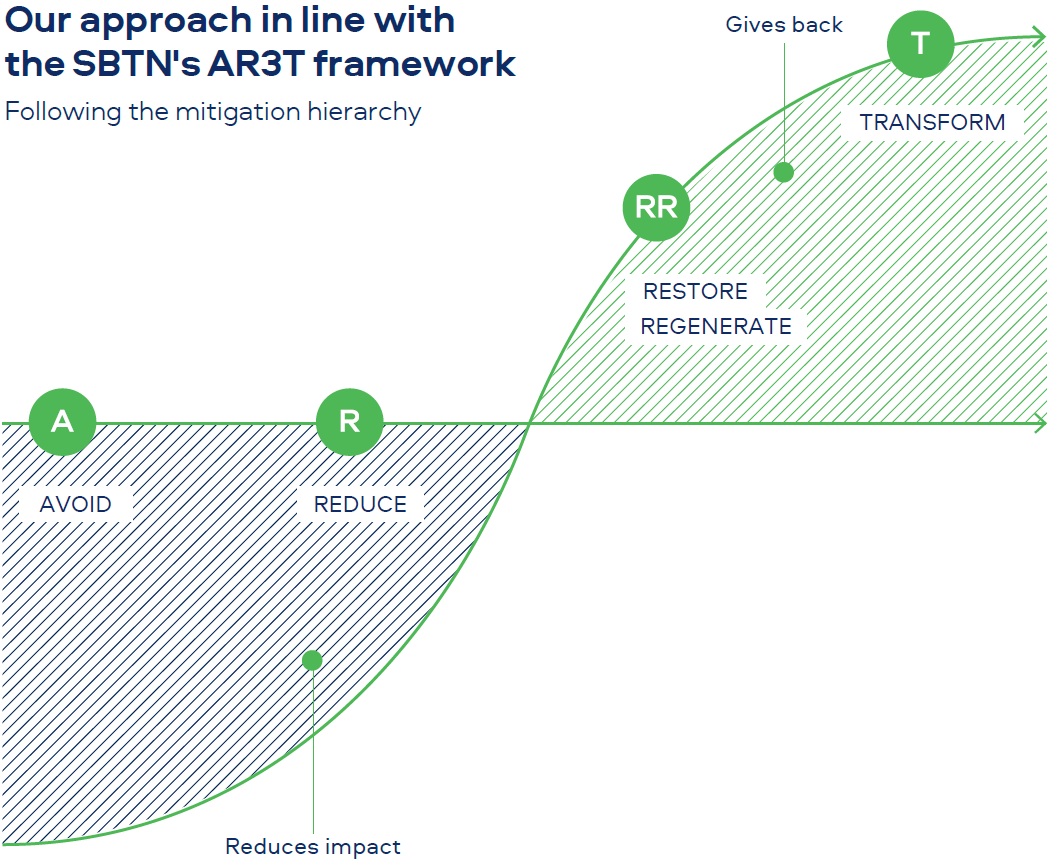
1. AVOID
- Deforestation and conversion in our tobacco supply chain
- Deforestation in our pulp and paper supply chain
- The use of highly hazardous pesticides
2. REDUCE
- Use of agrochemicals where possible
- Water use across our own operations and tobacco supply chain
- Water risks in our tobacco supply chain through active stewardship
3. RESTORE AND REGENERATE
- Implement regenerative agriculture practices, and restore nature through our Forest Positive target
4. TRANSFORM
- Embed nature policies, target plans and activities across our operations and supply chain
Find out more on our Nature initiatives and performance in pages 94 - 103 of our 2025 Combined Annual and Sustainability Report, and the 2025 Sustainability Performance Data Book.
Our CDP Publications:
As part of our commitment to transparency in Nature, we provide information to CDP - a global environmental impact non-profit organisation, through its reporting frameworks.
Our submissions are below:
2025
CDP Questionaire - Climate Change (3.5 mb)
2024
CDP Corporate Questionnaire – Forest and Water sections (3.0 mb)
2023
Water Stewardship (950 kb)
Forests (64 kb)
2022
Water Stewardship 2022 (725 kb)
Forests 2022 (490 kb)
Notes:
1. According to The Nature Positive Initiative, 'Nature Positive' is a goal which refers to measurable outcomes that contribute to halting and reversing nature loss with significant benefits to society (www.naturepositive.org/about/the-initiative)
2. Water Positive means BAT would return more water to the environment through restoration, replenishment and regeneration projects than it withdraws for its own operations.
3. In-scope commodities (currently pulp and paper, tobacco, curing wood) are assessed for deforestation.
You might also be interested in

MORE IN: