

As we transition to A Better Tomorrow™, we are committed to doing so responsibly – by reducing our reliance on natural resources, managing our environmental impact and respecting human rights across our business operations and supply chain.
Through these actions, we are enhancing business resilience and positioning BAT for enduring success in a rapidly evolving landscape.
At the same time, we strive to create meaningful impact in the communities where we operate and empower our people to drive positive change.
Our Group sustainability strategy
We continue to embed sustainability across the business as a strategic lever, driving performance, enhancing resilience, and enabling long-term growth.
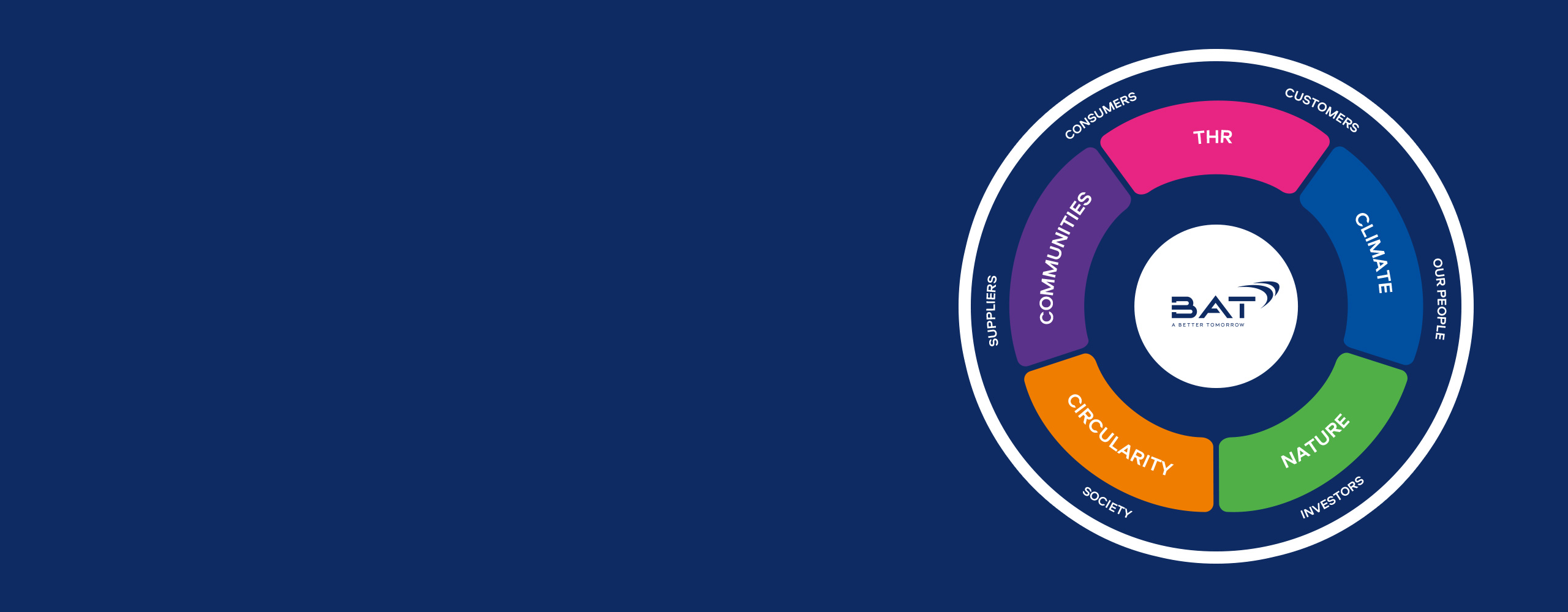
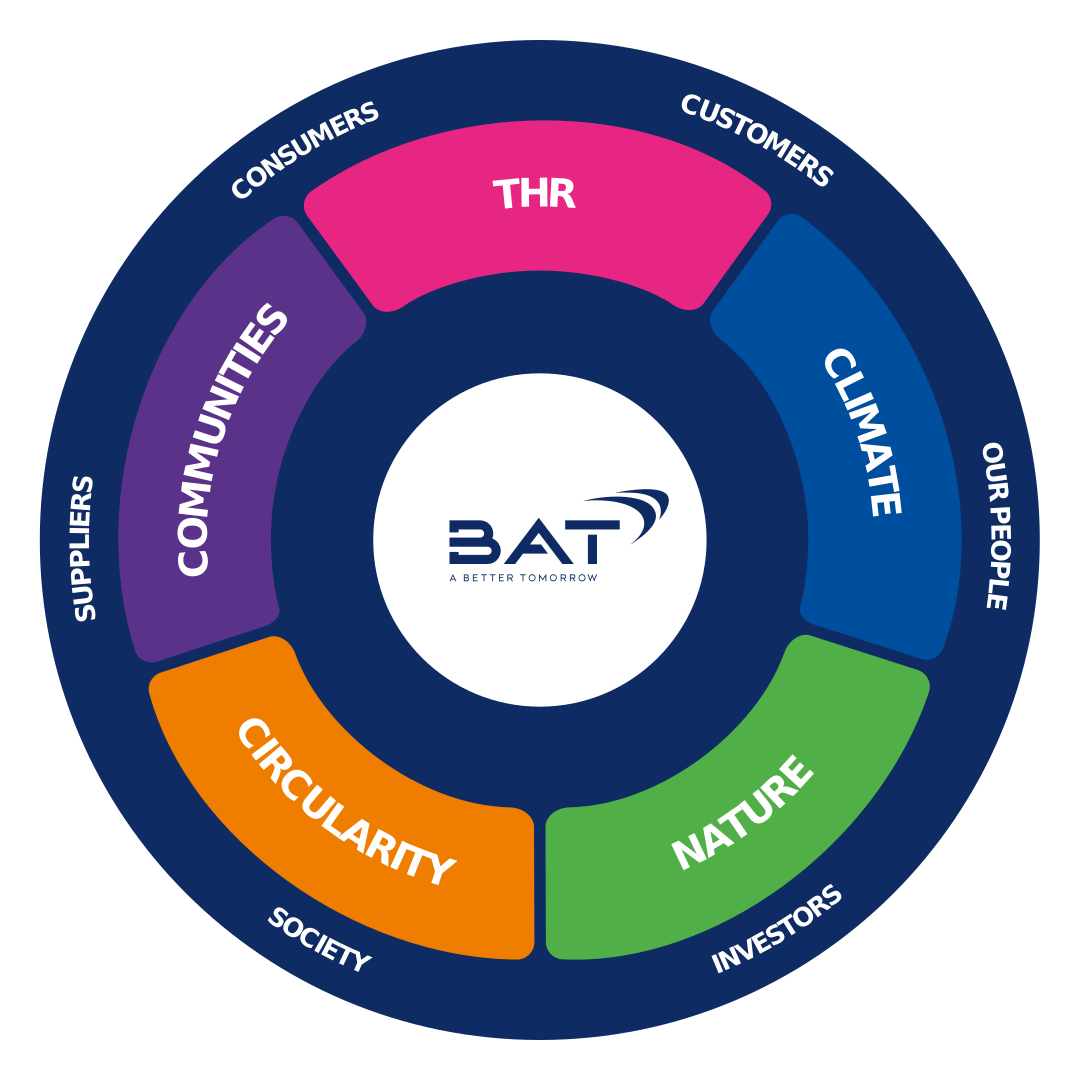
To achieve this, we have a sustainability strategy anchored in four interconnected impact areas beyond THR: Climate, Nature, Circularity, and Communities.
Over the past decade, we’ve transformed our business and made strong progress toward our goals but building a smokeless world comes with challenges.
We believe evidence‑based regulation and strong enforcement are essential to reducing smoking rates. We work with public‑health authorities and regulators to help shape policies that support Tobacco Harm Reduction while protecting against underage access, environmental impacts, and advocating for high products standards.
Our Group’s climate strategy is guided by our Low Carbon Transition Plan, aligned with the Paris Agreement’s 1.5°C pathway. We’re implementing science‑based targets and building a climate‑resilient supply chain.
Our nature strategy is anchored on the mitigation hierarchy in line with the Science Based Targets Network’s (SBTN) AR3T framework, comprised by four steps: Avoid, Reduce, Restore/ Regenerate and Transform. This means that our commitment to nature goes beyond managing impacts and dependencies as we aim to contribute towards a Nature Positive* future by protecting, restoring, and replenishing ecosystems.
Circularity is a key enabler to our transformation towards a Smokeless World. Our circularity strategy spans the entire product lifecycle, guided by eco-design principles that prioritise durability, low-carbon materials, and end-of-life recovery.
At BAT, our communities are central to sustaining long‑term, responsible growth. From strengthening employee engagement and equity, to supporting farmers through diversification and training, to building capability and stronger standards across our supplier network.
2030 targets
As our 2025 targets reach maturity, we’re proud of our achievements to date while recognising that further progress needs to be made. Guided by our Double Materiality Assessment**, we are setting new 2030 sustainability targets across all four of our strategic impact areas: Climate, Nature, Circularity and Communities.
Our new 2030 sustainability targets
This section presents our updated and new targets and ambitions for 2030. Our performance against these targets will be reported in our FY26 Combined Annual and Sustainability Report. The complete set of targets – along with details on updates, retirements, and resets – is available in our 2025 Sustainability Performance Data Book.
CLIMATE
Remaining committed to our science-based GHG emissions reduction targets, while acknowledging our dependency on local grid decarbonisation.
NATURE
Supporting our long-term resilience through targets for protecting and restoring the natural resources that we rely on.
CIRCULARITY
Broadening the scope of circularity targets, in line with our overall transformation strategy.
COMMUNITIES
Strengthening social and supply chain resilience through new targets for farming, supplier and employee communities.
60% absolute reduction in Scope 1 and 2 GHG emissions (versus 2020 baseline)1
WATER POSITIVE in our own operations2
50,000t reduction in total product material use4
90% of farming community households engaged in livelihood programmes in priority geographies
30.3% reduction in Scope 3 (Forest, Land and Agriculture) FLAG emissions (versus 2020 baseline)1
100% of prioritised water-stressed agricultural basins with water stewardship programmes
100% of New Category products and packaging launched with eco-design principles5
ZERO tolerance for child and forced labour in our supply chain8
42% reduction in Scope 3 industrial (non-FLAG) emissions (versus 2020 baseline)1
DEFORESTATION FREE across our primary deforestation-linked commodities3
100% Vapour devices to have removable batteries6
100% of prioritised non-tobacco suppliers engaged in our enhanced Human Rights Due Diligence Framework
>50% of energy used in own operations to be from low-carbon sources
65% of directly-contracted arable land adopting regenerative agriculture practices
100% of markets investing in consumer education programmes for the responsible disposal of our New Category products7
>85 Employee Engagement Index9
Notes:
- Compared to a 2020 baseline. Our near-term 2030 science-based targets comprise a 50% reduction in Scope 1 and 2 GHG emissions. We have set an updated corporate target of 60% reduction in Scope 1 and 2 GHG emissions, reflecting our ambition to go beyond our current Science-Based Target. The Scope 3 industrial (non-FLAG) GHG emissions target includes purchased goods and services, upstream transportation and distribution, use of sold products, and end-of-life treatment of sold products. The Scope 3 FLAG GHG emissions target includes FLAG emissions and removals. Combined, these targets comprised 77% of Scope 3 emissions in 2020. Due to the complexity of consolidating Scope 3 data from our suppliers and value chain, we report Scope 3 data one year behind other metrics. Refer to the BAT ‘Reporting Criteria’ for our full methodology: bat.com/reporting.
- Water Positive means BAT would return more water to the environment through restoration, replenishment and regeneration projects than it withdraws for its own operations.
- In-scope commodities (currently pulp and paper, tobacco, curing wood) are assessed for deforestation.
- Excludes materials where regulatory restrictions prevent reduction.
- Excludes single-use Vapour products. Eco-design principles guide the design and development of products with lower environmental impact, emphasising the use of renewable or recyclable materials, reducing CO2 emissions, and enhancing recyclability, durability, longevity and reusability.
- Excludes markets where regulatory constraints prevent battery removability.
- Excludes markets where regulatory constraints prevent implementation.
- Due to the complex and systemic nature of child and forced labour, this represents an ongoing ambition rather than a time-bound target.
- Employee Engagement Index focuses on employees’ connection to their organisation, marked by committed effort to achieve goals (being engaged) in environments that support productivity (being enabled) and maintained personal wellbeing (feeling energised).
Notes:
*According to The Nature Positive Initiative, 'Nature Positive' is a goal which refers to measurable outcomes that contribute to halting and reversing nature loss with significant benefits to society (www.naturepositive.org/about/the-initiative).
**Although financial materiality has been considered in the development of our Double Materiality Assessment (DMA), our DMA and any conclusions in this document as to the materiality or significance of sustainability matters do not imply that all topics discussed therein are financially material to our business taken as a whole, and such topics may not significantly alter the total mix of information available about our securities.
You might also be interested in

MORE IN: