


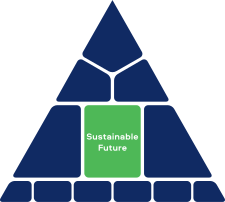
Sustainable Future
Building a Sustainable Future is about seeking to actively migrate adult smokers, who would otherwise continue to smoke, from cigarettes to smokeless alternatives responsibly and with integrity.
Science will be a primary driver of our efforts, supported by more active external engagement and regulatory focus, while embedding sustainability across our organisation.
- Tobacco Harm Reduction Acceptance
- Shaping the Landscape
- Leading in Sustainability and Integrity
- Building a Smokeless World
- Investing in the products, science and engagement to make A Better Tomorrow™ a reality
- Conducting our business responsibly and with integrity
Tobacco Harm Reduction (THR) Acceptance
Reducing the health impact of our business by Building a Smokeless World is crucial to a sustainable future. We believe, with greater acceptance of Tobacco Harm Reduction (THR) as a public health strategy, a Smokeless World can be achieved. This would ultimately be evidenced by a significant reduction in projected population level smoking-related morbidity and mortality.
Shaping the Landscape
Societal understanding of nicotine is crucial in THR. A common misconception is that nicotine, as a substance, is the primary cause of smoking-related diseases. However, the cause of the vast majority of such diseases is not exposure to nicotine, but the toxicants released by the burning of tobacco.
Adult consumer choice is an important component of THR success. We recognise that smokers, who would otherwise continue to smoke, are more likely to switch to Smokeless alternatives when they find a product that delivers convenience and similar sensorial satisfaction.
Our Ten THR Beliefs
In our view, the fastest and most effective way to achieve a Smokeless World is to embrace THR as a public health strategy for those who would otherwise continue to smoke.
Our ambition to reduce the health impacts of our business is clear. For many years we have worked diligently to develop and offer a range of reduced-risk*† tobacco and nicotine products compared to cigarettes. This fulfils a core part of the THR equation; we provide those adult smokers who would otherwise continue to smoke with options to switch completely to smokeless alternatives.
While progress has been made, there is still more to do to make a Smokeless World a reality. Through our Ten Beliefs, our commitment to THR is reaffirmed, recognising the significant opportunity it presents to Build a Smokeless World.
We have invested significantly in THR through the development of our portfolio of Smokeless products. This has resulted in Smokeless products becoming more acceptable to those who would otherwise continue to smoke, and commercially sustainable. Our engagement with regulators and policy makers on THR is underpinned by our open and transparent regulatory positions.
We believe:
-
1
A Smokeless World is possible.
-
2
Tobacco Harm Reduction (THR), underpinned by robust science, is the best route to a Smokeless World.
-
3
The weight of evidence supports THR today.
-
4
The public health community should embrace THR and smokeless alternatives, not prohibition.
-
5
Tobacco and nicotine are for adults only and
never for the underaged. -
6
Adult nicotine consumers should have access to information about smokeless alternatives and the right to make informed choices.
-
7
If you don't smoke, don't start. If you smoke, quit. If you choose not to quit, switch completely to Smokeless products.
-
8
Innovation and a well-regulated, responsible marketplace are critical to enabling THR.
-
9
No one can drive a Smokeless World alone.
-
10
A Better Tomorrow™ is a Smokeless World.
Omni™ – one year on
In 2025 we celebrated a year of Omni™, our dynamic resource and manifesto for change. From achieving over 12,000 downloads and launching in 23 markets across the world, to winning awards externally, our ground-breaking platform continues to evolve.
Omni™ was named the Global PR Campaign of the Year at the 2025 Platinum PR Awards in New York, and was also recognised by one of Spain’s leading newspapers, La Razón, winning the Innovative and Transformative Initiative Driving Change Towards a Smoke-Free World award.
Our ambition to lead the THR conversation through robust science and evidence is fundamental. As evidence and science progress, so will Omni™, and we will continue to offer insights and drive progress to Build a Smokeless World and create A Better Tomorrow™.
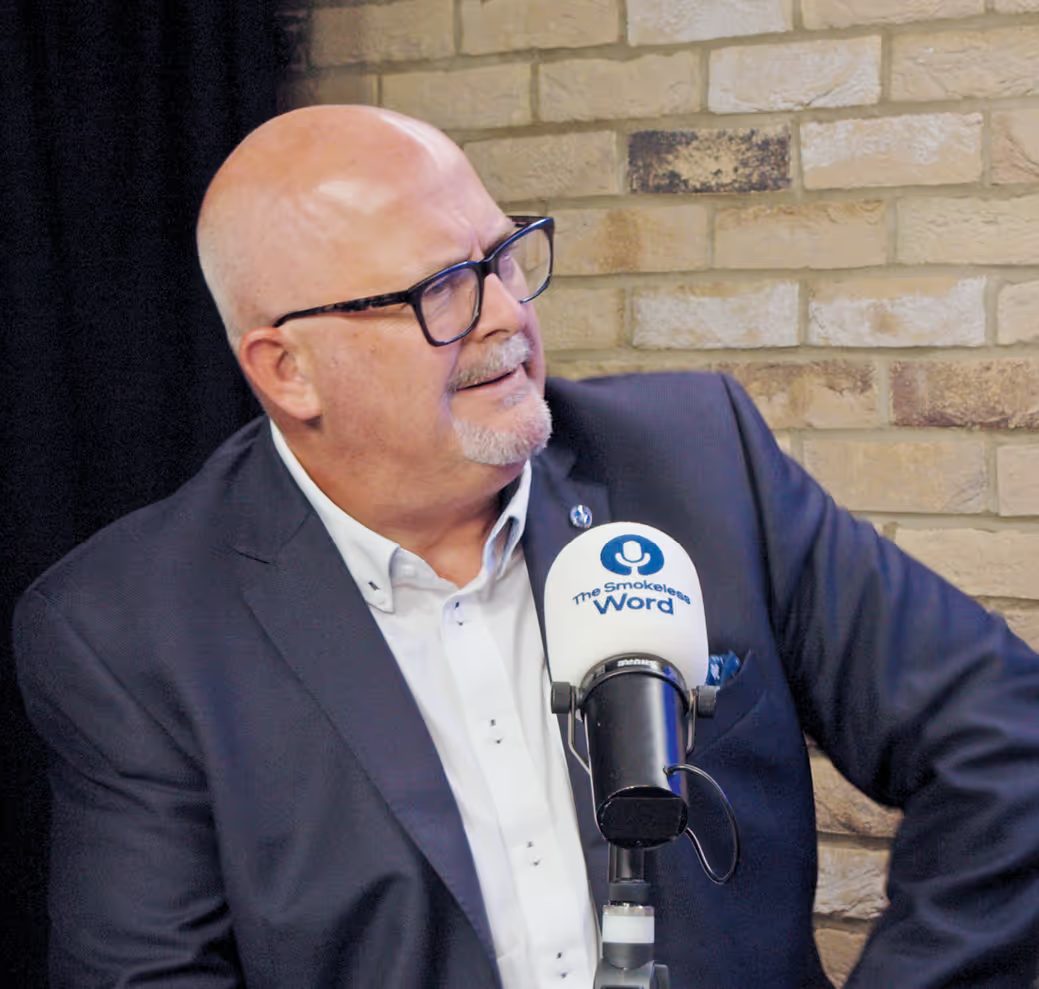
Another THR milestone in 2025 was the launch of The Smokeless Word podcast – inspired by themes from Omni™. Hosted by our Chief Corporate Officer, Kingsley Wheaton, and available on all streaming platforms, listeners are invited to explore new perspectives on what Building a Smokeless World means.
The thought-provoking series has grown in popularity, garnering over 23 million views5 in 2025, and provides reflective, unfiltered conversations with a wide range of guests.
Based on the weight of evidence and assuming a complete switch from cigarette smoking. These products are not risk free and are addictive.
Products sold in the U.S., including Vuse, Velo, Grizzly, Kodiak, and Camel Snus, are subject to FDA regulation and no reduced-risk claims will be made as to these products without agency clearance.
- Word Health Organization, WHO report on the global tobacco epidemic 2021: addressing new and emerging products. 2021. Available at: https://iris.who.int/handle/10665/343287
- Lindson N, Butler AR, McRobbie H, Bullen C, Hajek P, Begh R, Theodoulou A, Notley C, Rigotti NA, Turner T, Livingstone-Banks J, Morris T, Hartmann-Boyce J.
Electronic cigarettes for smoking cessation. Cochrane Database of Systematic Reviews 2024, Issue 1. Art. No.: CD010216. DOI: 10.1002/14651858.CD010216.pub8 - Tobacco Intelligence, Regulatory & Market Intelligence for Alternative Tobacco & Nicotine Products, Nicotine Pouch Market Database, Quarter 1 Report. 2024.
- WHO global report on trends in prevalence of tobacco use 2000-2024 and projections 2025-2030. Geneva: World Health Organization; 2025. Available at: www.who.int/publications/i/item/9789240116276
- Organic, paid and YouTube views of The Smokeless Word podcast in 2025
Sustained Transformation
As the external sustainability landscape evolves, our operating model, data, and digital capabilities will enable us to navigate and adapt with confidence.
Jonathan Upward
Chief Sustainability Officer
Note:
^ Although financial materiality has been considered in the development of our Double Materiality Assessment (DMA), our DMA and any conclusions in this document as to the materiality or significance of sustainability matters do not imply that all topics discussed there in are financially material to our business taken as a whole, and such topics may not significantly alter the total mix of information available about our securities.
Our sustainability strategy
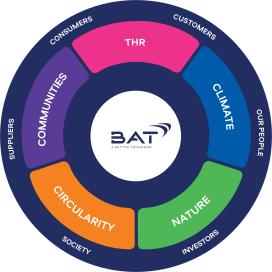
In addition to THR, our sustainability strategy is anchored in four interconnected impact areas:
Our new 2030 sustainability targets
This page presents our updated and new targets and ambitions for 2030. Their performance will be reported in our FY26 Combined Annual and Sustainability Report. The complete set of targets – along with details on updates, retirements, and resets – is available in our 2025 Sustainability Performance Data Book.
Climate
Remaining committed to our science-based emission reduction targets, while acknowledging our dependency on local grid decarbonisation.
Nature
Supporting BAT’s long-term resilience through targets for protecting and restoring the natural resources that we rely on.
FREE
CIRCULARITY
Broadening the scope of circularity targets, in line with BAT’s overall transformation strategy.
Communities
Strengthening social and supply chain resilience through new targets for farming, supplier and employee communities.
- Compared to a 2020 baseline. Our near-term 2030 science-based targets comprise a 50% reduction in Scope 1 and 2 GHG emissions. We have set an updated corporate target of 60% reduction in Scope 1 and 2 GHG emissions, reflecting our ambition to go beyond our current Science-Based Target. The Scope 3 industrial (non-FLAG) GHG emissions target includes purchased goods and services, upstream transportation and distribution, use of sold products, and end-of-life treatment of sold products. The Scope 3 FLAG GHG emissions target includes FLAG emissions and removals. Combined, these targets comprised 77% of Scope 3 emissions in 2020. Due to the complexity of consolidating Scope 3 data from our suppliers and value chain, we report Scope 3 data one year behind other metrics. Refer to the BAT ‘Reporting Criteria’ for our full methodology: bat.com/reporting.
- Water Positive means BAT would return more water to the environment through restoration, replenishment and regeneration projects than it withdraws for its own operations.
- In-scope commodities (currently pulp and paper, tobacco, curing wood) are assessed for deforestation.
- Excludes materials where regulatory restrictions prevent reduction.
- Excludes single-use Vapour products. Eco-design principles guide the design and development of products with lower environmental impact, emphasising the use of renewable or recyclable materials, reducing CO2 emissions, and enhancing recyclability, durability, longevity and reusability.
- Excludes markets where regulatory constraints prevent battery removability.
- Excludes markets where regulatory constraints prevent implementation.
- Due to the complex and systemic nature of child and forced labour, this represents an ongoing ambition rather than a time-bound target.
- Employee Engagement Index focuses on employees’ connection to their organisation, marked by committed effort to achieve goals (being engaged) in environments that support productivity (being enabled) and maintained personal wellbeing (feeling energised).
Concluding our current sustainability targets
This page presents a selection of our current targets and our performance against them. Our performance against the complete set of current sustainability targets is reported in our 2025 Sustainability Performance Data Book.
Our THR targets extend beyond 2025, they remain central to tracking our performance against our long‑term ambition to build a Smokeless World.
Similarly, while our current climate targets run through 2030, the progress we have already made against them has enabled us to enhance our commitments beyond our current Science Based Targets initiative (SBTi) target.
Together with our progress across our impact areas, these targets strengthen the foundation for sustainable growth.
Concluding our current 2025 targets marks a key milestone in our sustainability journey.
We are proud of our achievements to date, making significant progress in reducing our GHG emissions, achieving all of our water targets and some of our operational waste reduction targets.
We recognise that further progress still needs to be made. We remain focused on closing the gaps and addressing challenges as they evolve.
Our new and updated 2030 targets are detailed above.
We have made progress on our goals while maintaining our dedication to high product quality and responsible product stewardship.

introduced in 2024 and recognised at the Global Platinum PR Awards, marking our efforts to reframe Tobacco Harm Reduction.
-enabled vapour products launched in three markets in 2025.
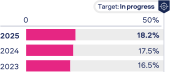
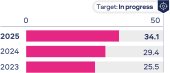
- The revision from 29.1 million to 29.4 million users in 2024 reflects survey methodology enhancements. In Germany, moving from telephonic to web-based interviews has a net impact of +0.4mn and the introduction of Track in Finland has an impact of -0.03mn. 2025 market research assumptions have been applied to previous years to prevent any trend breaks. 2023 data excludes Russia and Belarus.
We started its implementation in 2025, built on the Microsoft Sustainability Manager. The system centralises climate-related data, supporting regulatory compliance and better decision-making.
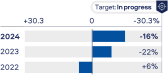
reduction in Scope 1, 2, and 3 GHG emissions between 2020 and 2024, equivalent to 1,323 ktCO₂e.

rating from CDP for our 2024 and 2025 disclosures on Climate Change, Water Security and Forest.
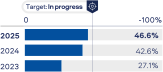
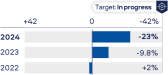
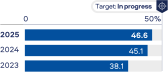
We rolled out our Regenerative Agriculture Framework across key tobacco sourcing regions. The outcomes of ongoing pilot initiatives will inform our strategic direction to 2030.

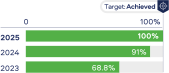
Alliance for Water Stewardship (AWS)1 certification across all our manufacturing sites achieved in 2025.
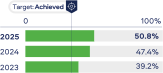
reduction in water withdrawn in 2025 (versus 2017 baseline), surpassing our target of 35% which was achieved two years ahead of schedule in 2023.
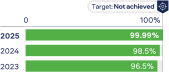
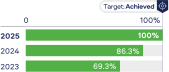
- AWS certification refers to independent certification against the Alliance for Water Stewardship (AWS) Standard 2.0.
We launched our premium Vapour device with a removable battery, Vuse Ultra, marking a key step toward extending product life and helping to facilitate recycling.
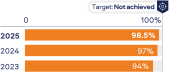
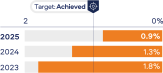
of our operational waste going to landfill achieved in 2025.

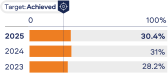
reduction in absolute volume of operational waste generated in 2025 (versus 2017 baseline), with this 25% target achieved two years ahead of schedule in 2023.
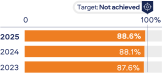
We met our 2025 target for 100% of product materials and Higher-Risk Indirect Suppliers‡ to have undergone at least one independent labour audit within a three-year cycle.

of our farmers in the Thrive Supply Chain were reported to have diversified crops in 2025.
pay gap between permanent BAT male and female employees maintained since 2021.
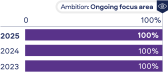
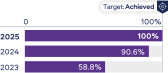
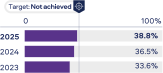
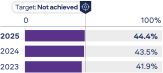
For a full description of key terms and definitions, refer to the BAT 'Reporting Criteria' in our 2025 Sustainability Performance Data Book at bat.com/reporting
- The revision from 29.1 million to 29.4 million users in 2024 reflects survey methodology enhancements. In Germany, moving from telephonic to web-based interviews has a net impact of +0.4mn and the introduction of Track in Finland has an impact of -0.03mn. 2025 market research assumptions have been applied to previous years to prevent any trend breaks. 2023 data excludes Russia and Belarus.
- Environmental, health and safety data in relation to our own operations is reported for the period 1 December 2024 to 30 November 2025.
- Compared to a 2020 baseline. Our current near-term 2030 science-based targets comprise a 50% reduction in Scope 1 and 2 GHG emissions. We have set an updated corporate target of 60% reduction in Scope 1 and 2 GHG emissions, reflecting our ambition to go beyond our current Science-Based Target. The Scope 3 industrial (non-FLAG) GHG emissions target includes purchased goods and services, upstream transportation and distribution, use of sold products, and end-of-life treatment of sold products. The Scope 3 FLAG GHG emissions target includes FLAG emissions and removals. Combined, these targets comprised 77% of Scope 3 emissions in 2020. Due to the complexity of consolidating Scope 3 data from our suppliers and value chain, we report Scope 3 data one year behind other metrics. Refer to the BAT ‘Reporting Criteria’ for our full methodology: bat.com/reporting.
- Renewable energy includes: Energy generated from renewable fuels at our sites (e.g. wood fuel, biomass fuels) and in fleet vehicles, owned or leased (e.g. biodiesel); Purchased renewable electricity, hot water and steam; and Renewable energy generated on site using non-fuel technology (e.g. with photovoltaic installations or solar water heaters).
- Our calculation excludes about 1.7% of total material used in our packaging, representing exclusions due to regulatory requirements in certain markets and adhesives used in packaging.
- These Group-wide targets do not represent quotas. For each vacancy, the most suitable candidate, regardless of their gender or ethnicity, should be hired. We also recognise that there may be local requirements or other circumstances that need to guide our hiring practices in various locations where we operate. For example, Reynolds American Inc. does not establish or work towards achieving representation targets.